Turkish Suffixes: How One Word Becomes a Sentence
Those famously long Turkish words are just Lego. Learn how suffixes stack and you learn how Turkish thinks.
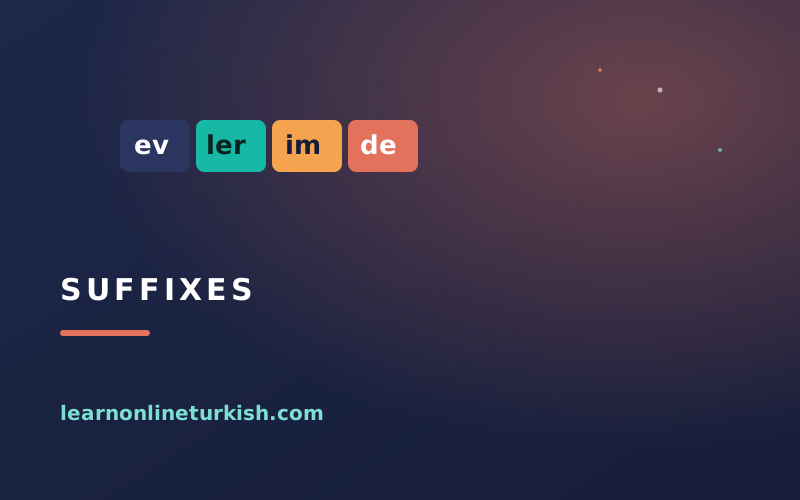
You have probably seen a joke about a Turkish word that is longer than an entire English sentence. There is truth in it — and once you understand why, it becomes one of the most satisfying things about the language. Turkish stacks small, predictable pieces onto a root, like Lego. Learn the pieces and you can build — and read — almost anything.
Agglutination: building meaning in layers
Turkish is an agglutinative language. Instead of separate words like "in", "my", "houses", it glues suffixes onto a root in a fixed order. Each suffix adds one clear piece of meaning.
Watch a word grow
| Turkish | Meaning |
|---|---|
| ev | house |
| evler | houses |
| evlerim | my houses |
| evlerimde | in my houses |
| evlerimdeydi | it was in my houses |
Nothing is random. Each layer — plural, "my", "in", "was" — attaches in a set order, each obeying vowel harmony. Read them right to left in meaning and the long word decodes itself.
جملتك التركية الأولى على بُعد رسالة واحدة.
The fixed order is your friend
Because suffixes always appear in the same sequence (roughly: root → plural → possessive → case → tense/person), you are never guessing. Once you internalise the order, you can unpack a scary-looking word in seconds and build your own.
Why this makes Turkish predictable
English hides meaning in irregular spellings and exceptions. Turkish puts meaning out in the open, one labelled block at a time. That regularity is exactly why learners who push through the first month often say Turkish becomes easier as they go, not harder.
How to practise stacking
Take a single root — git ("go"), gel ("come") — and add one suffix at a time out loud, checking your harmony. In lessons we do this live, so a mistake gets caught and corrected the instant it happens, which is how the pattern becomes muscle memory.